

Becoming a Restorative Practitioner

[The following post is an introduction to Loomis Chaffee’s January 5th professional development programming with Joe Brummer, one of the world’s leading experts in trauma-informed restorative practices.]
I often return to Dave Stuart Jr.’s notion of teaching as work oriented toward the “long-term flourishing” of children. In doing so, I find myself reflecting on how I am preparing my students not only to thrive in their present lives but also to navigate a future that will be marked by profound change and instability.
Recently, I have begun to associate this work with small acts of intervention: deliberate ways of disrupting tendencies that, if allowed to accumulate and gather force, can crystallize into patterns of alienation or trauma. Reframing my work in this way has required me to slow down and take stock of how such tendencies are shaped not only by obvious factors—bullying, for example—but also by institutional structures that deprive students of access to meaningful and equitable forms of relational accountability.
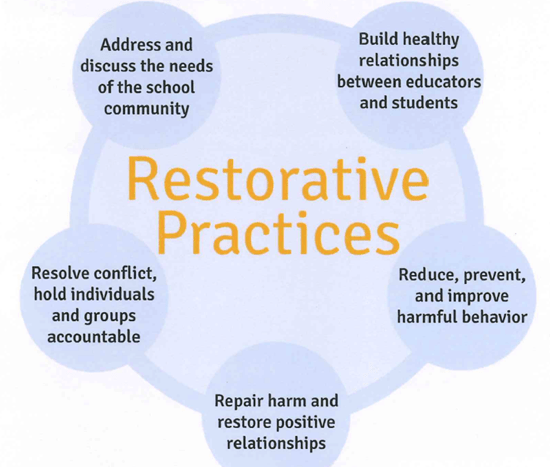
This ethos aligns closely with what many would call a mode of restorative practice: a way of educating that attends not merely to deterring harm but to cultivating the capacities students need in order to understand harm, rebuild connection, and re-establish relationships of trust. Underlying the application of restorative practice to the field of education is the recognition that such capacities become especially important in U.S. social contexts where accountability can quickly become reduced to retributive or punitive dynamics that inhibit students’ agency.
We often assume that these retributive or punitive dynamics are effective simply because they are familiar and, as a result, we overlook their cumulative influence on community life. Yet shouldn’t we examine what happens in schools when we choose to identify accountability with such dynamics?
Dr. Carla Shalaby tells us that our students come to discern in these mechanics of behavior management a series of lessons—a hidden curriculum in which what they learn is not merely the wrongfulness of their actions but also that certain goals can only be met through the exertions of a social power that excludes, humiliates, and coerces.[1] Without practices of intervention that unpack this curriculum and work to change it, we risk modeling a kind of accountability that engenders and manipulates cycles of emotional dysregulation. In turn, we teach our students not how to repair harm, but how to weaponize authority within social and psychical relations that are inherently unequal.
To intervene in these dynamics, I approach restorative practice as a toolkit that empowers me to model alternative arrangements of power. In these arrangements, authority gives structure to practices of care by resisting coercion and sustaining conditions of recognition, agency, and belonging.
I do not consider these conditions to be luxuries or the unearned spoils of an era in which our idea of school discipline has suddenly “gone soft.” Rather, I think of them as foundational to the healthy development and future success of all young people.
Follow-Up Questions:
1. When we talk about authority that resists coercion and sustains agency and belonging, what does that look like in your role? When have you seen it enacted well?
2. What barriers—structural, cultural, or emotional—get in the way of restorative approaches in your context? What would need to shift to make restorative practice more sustainable or authentic?
3. What is one belief you hold about discipline or accountability that this post challenges or complicates? How does that belief show up in your daily work?
4. If students were asked how their community responds to harm, what stories or examples would they likely share? What would you want to be the focus or lesson of those stories?
[1] Carla Shalaby, “Imagining ‘Classroom Management’ as an Abolitionist Project,” in Lessons in Liberation: An Abolitionist Toolkit for Educators, ed. Bettina L. Love et al. (Chicago: Haymarket Books, 2021).