

Giving Honest Feedback
The Radical Candor Framework

Earlier this month, I had the privilege of attending the Instructional Coaching Group’s Teaching, Leading, Coaching conference in Phoenix, Arizona. During the conference, Kim Scott gave a keynote presentation on a framework she developed for having tough conversations, called Radical Candor, which she outlines in her book Radical Candor: Be a Kickass Boss Without Losing Your Humanity.
Feedback is central to our jobs as teachers, coaches, and leaders. But Scott argues that we often default to two unhelpful extremes. The first, “Ruinous Empathy,” occurs when we do not give honest feedback because we want to be kind. This leaves people unaware that change is even needed. The other, “Obnoxious Aggression,” happens when we give blunt, honest feedback in a way that feels mean, shuts the other person down, and makes them defensive rather than open to change.
To help visualize this, Scott maps feedback into four quadrants defined by two axes: caring personally (kindness) and challenging directly (clear, direct feedback).
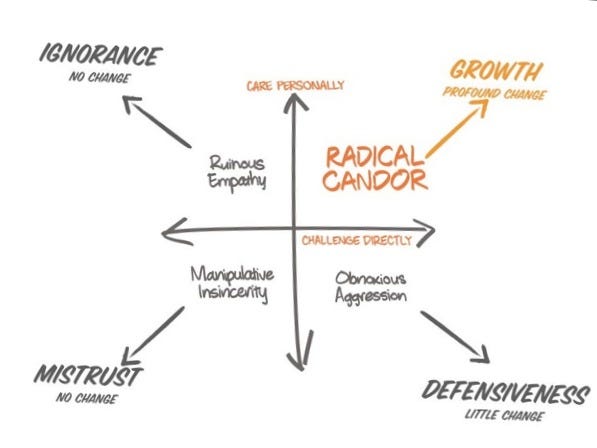
Scott argues that for change to happen, we must instead approach conversations in the “Radical Candor” quadrant. When I think back to the mentors who shaped me the most, they were the ones who told me the truth, even when I didn’t want to hear it. I might not have liked it in the moment, but I never doubted they were on my side, and their honesty helped me to stop, take stock of what I was doing, and make change for the better, instead of unknowingly continuing along a “wrong” path. That’s exactly what Scott is talking about - being willing to say the hard thing in a way that still makes it clear that you have the person’s best interests at heart.
If you are interested in learning more, I recommend listening to Kim Scott’s Ted Talk: How to Lead with Radical Candor
Scott’s Radical Candor framework can apply to our work with students and with colleagues. Consider the following reflection questions:
Where on the quadrant do you tend to fall with tough conversations? Does it make a difference whether feedback is intended for a student or a colleague?
Think of a time you didn’t give honest feedback because you wanted to be kind. What happened as a result? How might you approach that conversation differently now?
Think of a mentor/coach/teacher who told gave you feedback with “radical candor.” What made their honesty feel caring instead of harsh?
Great stuff Lauren! I wonder how much this can be student driven….asking students for great examples in their own past when coaches teachers and parents had given effective feedback as well as feedback that led to negative reactions on their part. Then to press them to wonder what will make them better and stronger and to push them to want more radical candor…
Claude Steele et al. coined the term "mentors dilemma" which is that while we must provide students with information they need to improve their work, criticism has the potential to undermine confidence and motivation. Research has shown that this is specially fraught for minority students. In his book Belonging, Goeffrey Cohen writes about giving "wise criticisms" to deal with that challenge.