

Open Classroom Week

Each year, I see Open Classroom Week as an invitation to make the best part of a teacher’s work more visible. Teachers build a classroom culture that is uniquely theirs, a small community shaped with care, routines, relationships, and purpose. When we step into a colleague’s room, we see real strategies working with our students in our shared context, and when we welcome a colleague into our own room, we gain a fresh lens on routines and moments we rarely notice from inside the lesson. The Taylor Institute for Teaching and Learning at the University of Calgary’s guide for Teaching Squares captures what I hope this week can be for us, even though we are not running Teaching Squares formally. It describes peer observation as a way to enhance teaching and learning and build community through reciprocal observation, self-reflection, and discussion. It also emphasizes that the learning comes from watching colleagues and reflecting on what we notice for our own practice, which is a meaningful departure from observation that is primarily about evaluation and feedback. That is the mindset I want to bring both as a visitor and as a host.
To keep my classroom visits focused and practical, I am using a modified version of Taylor Institute’s “What, So What, Now What” Teaching Square reflection prompts as a simple lens for note-taking and reflection.
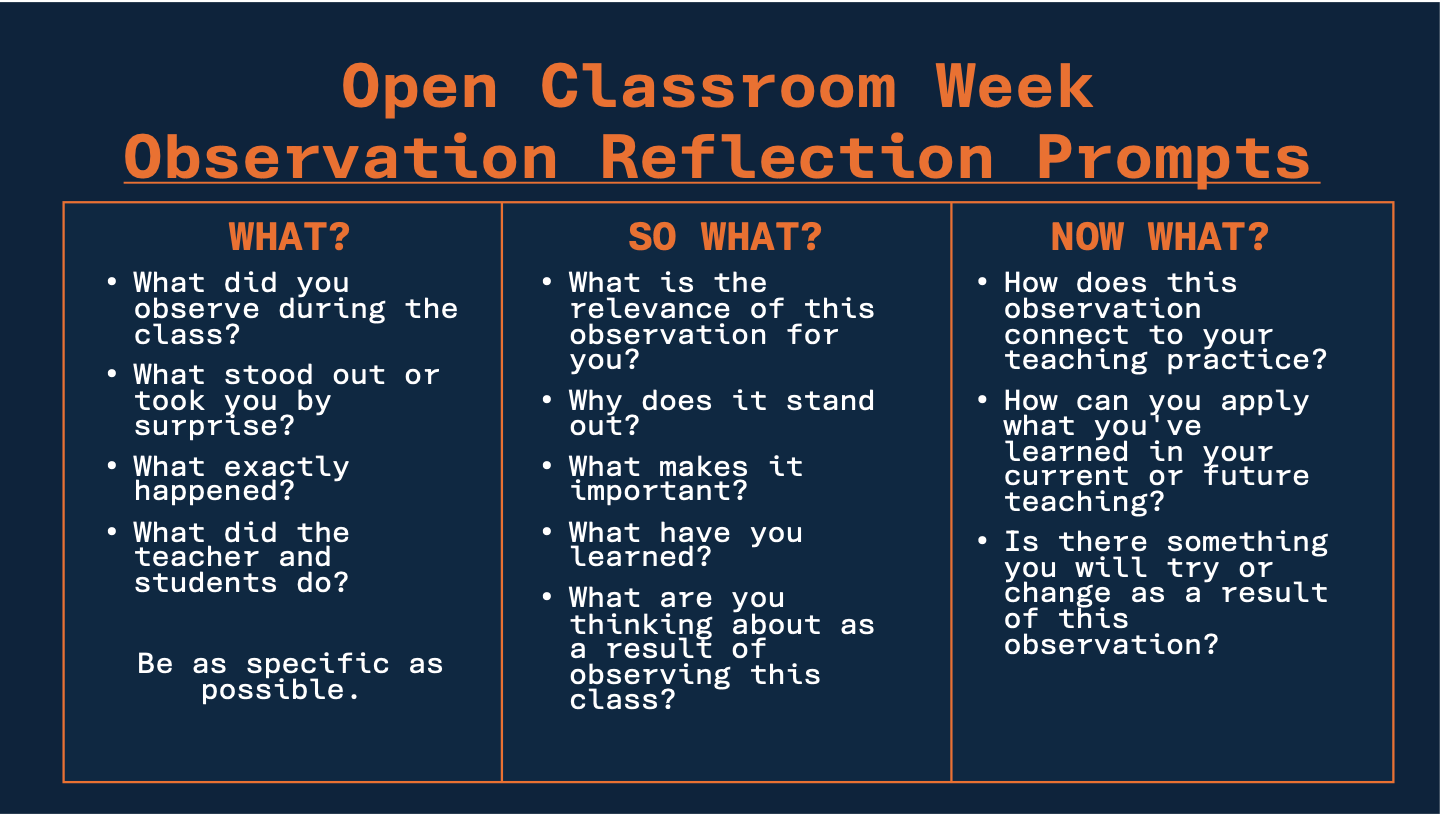
These reflection prompts keep the focus productive: examples of good teaching and learning I saw, what I learned from observing, and things I might try next. I also love the bigger questions as a lens for my note taking: what surprised me, what assumptions were challenged, and what is one thing I will apply in my own classes. That framing matches how I naturally approach observations. Sometimes, I visit teachers who are masters of a strategy I am working on. Other times, I sit in on a class that simply sounds interesting. And sometimes, I choose visits that could fuel interdisciplinary work aligned with our strategic plan. When peers visit my class, I am also hoping for insight that helps me see my own teaching more clearly, without turning it into evaluation. Using the same “What, So What, Now What” structure, I will invite visitors to share what they noticed, why it stood out, and what possibilities it suggests for my next steps. Then, I can do the most important part: reflect, choose one small change, and try it.
Taylor Institute for Teaching and Learning - The Teaching Squares Guide: Observe and Reflection Teaching and Learning - This guide leads readers through the process of organizing and implementing a Teaching Square and includes numerous tools and templates that can be used to support and enhance observation and critical reflection skills.
Note: Teaching Squares is a faculty development tool created by Anne Wessely from St. Louis Community College and adopted widely by colleges and universities.