

Cognition, connection, curiosity: How we care for our students’ brains and develop their habits of mind


Over the course of this academic year, three guest speakers have addressed Loomis Chaffee faculty on issues related to the brain. In this post, we hope to draw a throughline between these talks, summarize takeaways, and provide food for thought as we wrap up this school year and make plans for the next one. The most basic summary goes something like this: a rudimentary understanding of how our brains function is critical and should play a role in lesson and unit design and classroom management. This understanding must also inform our interactions with students exhibiting dysregulation. When we are transparent about the science that informs our pedagogical decisions, we help students develop more effective ways to learn and to self-regulate.
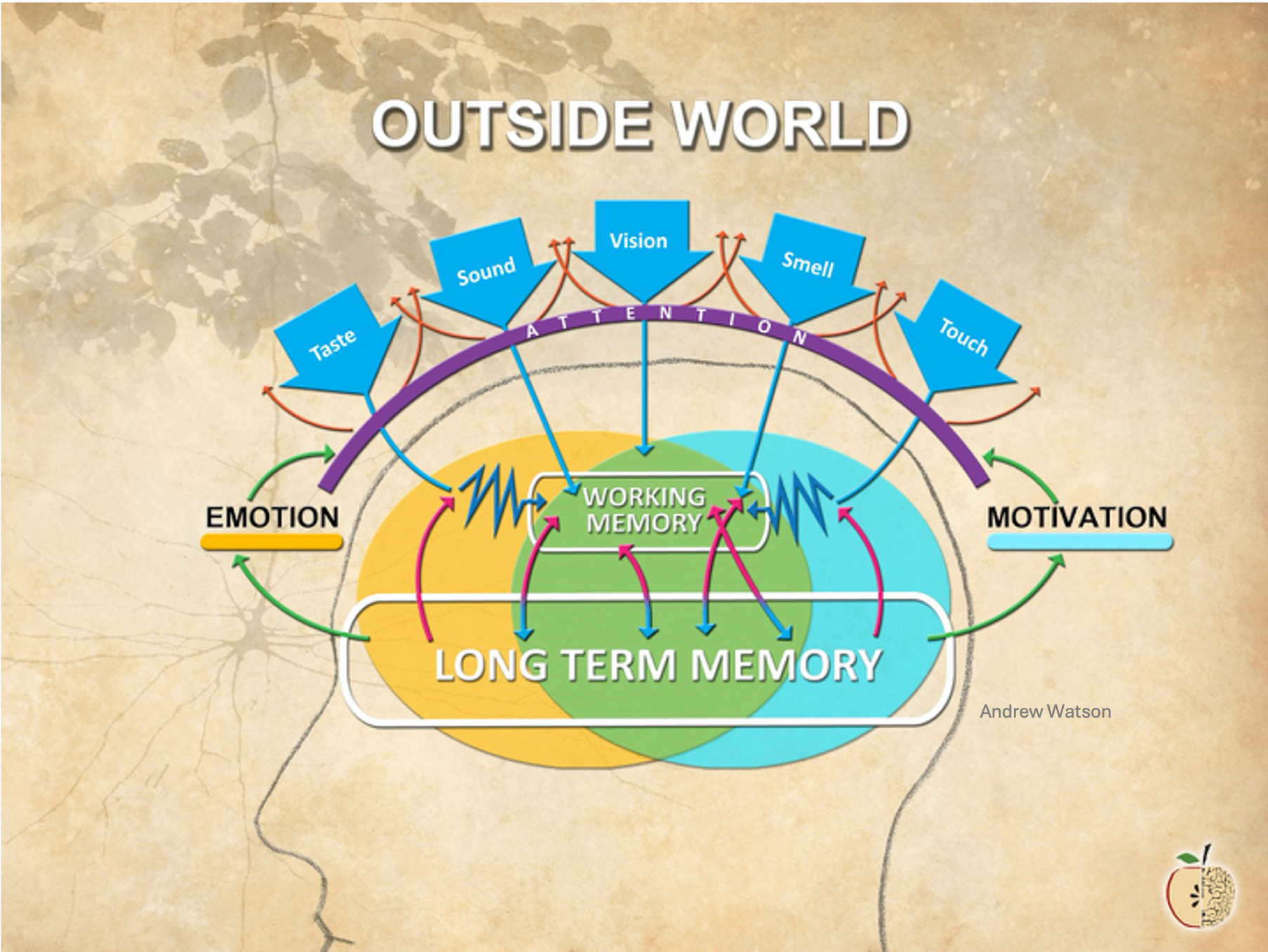
In August, Andrew Watson focused on how information moves from short-term to long-term memory and how working memory limits can impede this transfer. Watson provided the helpful mnemonic SHREK – select, hold, reorganize, kombine (combine) – which distills the processes students must undergo in order to access, utilize, and retrieve information from long-term memory. He emphasized that teachers must respect working memory limits and help students monitor for understanding. This is metacognition! Watson reminded us that the process of storing and retrieving information in long-term memory is part of a system that depends on working memory and impacted by many outside factors, including attention, emotion, and motivation.
In January, Joe Brummer, whose talk Sam Lagasse previewed in this post, discussed the neurobiology of psychological safety. Referencing the work of Bruce Perry, MD, Brummer presented a spectrum of mental states (from calm to terror) and explained that students’ cognitive and emotional states dictate what region of the brain is available for learning. The closer that students are to red on the spectrum, the harder it is for them to learn because their emotional state impacts cognitive load.

Brummer highlighted the importance of building trusting relationships with students in order to support them in developing self-regulation. Teachers can aid in this process by engaging in co-regulation with students as a preliminary step and to prepare them to self-regulate eventually.
At our March Faculty Day, Jud Brewer, MD discussed the habit-forming potential of anxiety. He explained that our brains get stuck in loops (trigger, behavior, reward), but that once we are aware of our brains’ patterns, we can work to undo them and form more healthy responses to triggers. Brewer asked that we notice habits (our own and students’) and use curiosity to break the cycle. This noticing is a form of mindfulness – taking note of WHAT is happening without examining WHY.
Following Brewer’s talk, many audience members had questions about Brewer’s advice to avoid prompting students to reflect on “the why” of their anxiety. Though unpacking the root causes of one’s anxiety with a trained therapist may be an important part of the healing journey for many, we teachers are not trained mental health professionals. In addition, encouraging students to engage in analysis of their anxiety may just cause more rumination. Instead, Brewer recommends prompting students to approach their symptoms from a mindfulness stance, which he believes will lead to better outcomes in the classroom. It is nevertheless important that students have a trusted adult outside of the classroom context with whom they can unpack their feelings and guide them to next steps (which may include clinical support).
Conclusion- TL;DR (too long; didn’t read) for faculty and staff
If you have a basic understanding of how memory functions, you can be more intentional with your lesson and unit design. (Watson)
It is difficult to learn if you are experiencing cognitive overload and/or dysregulation. (Brummer)
When you recognize negative thought patterns, you can move from reactivity to agency. (Brewer)
The more we as educators do to help students understand the above, the better prepared they will be to learn and function at an optimal level. (Watson, Brummer, and Brewer)
Another TL;DR:
Watson: As teachers, we prepare our lessons and units.
Brummer: We’re prepared for the unexpected.
Brewer: We notice what is going on with our students.
(p.s., it’s also good to know about our own brains)
 | A guest post by
|